Boutique Agency

6 March 2026
When Pablo Picasso moved permanently to the Côte d’Azur in 1946, he was no longer a searching artist but a world-famous icon. Yet southern France did not become a place of quiet retirement for him; it became the place where the boundary between his turbulent private life and his art dissolved completely. The houses he bought often functioned as mirrors of the women who, at that moment, were his muses.
The ‘tenant’ of Château Grimaldi
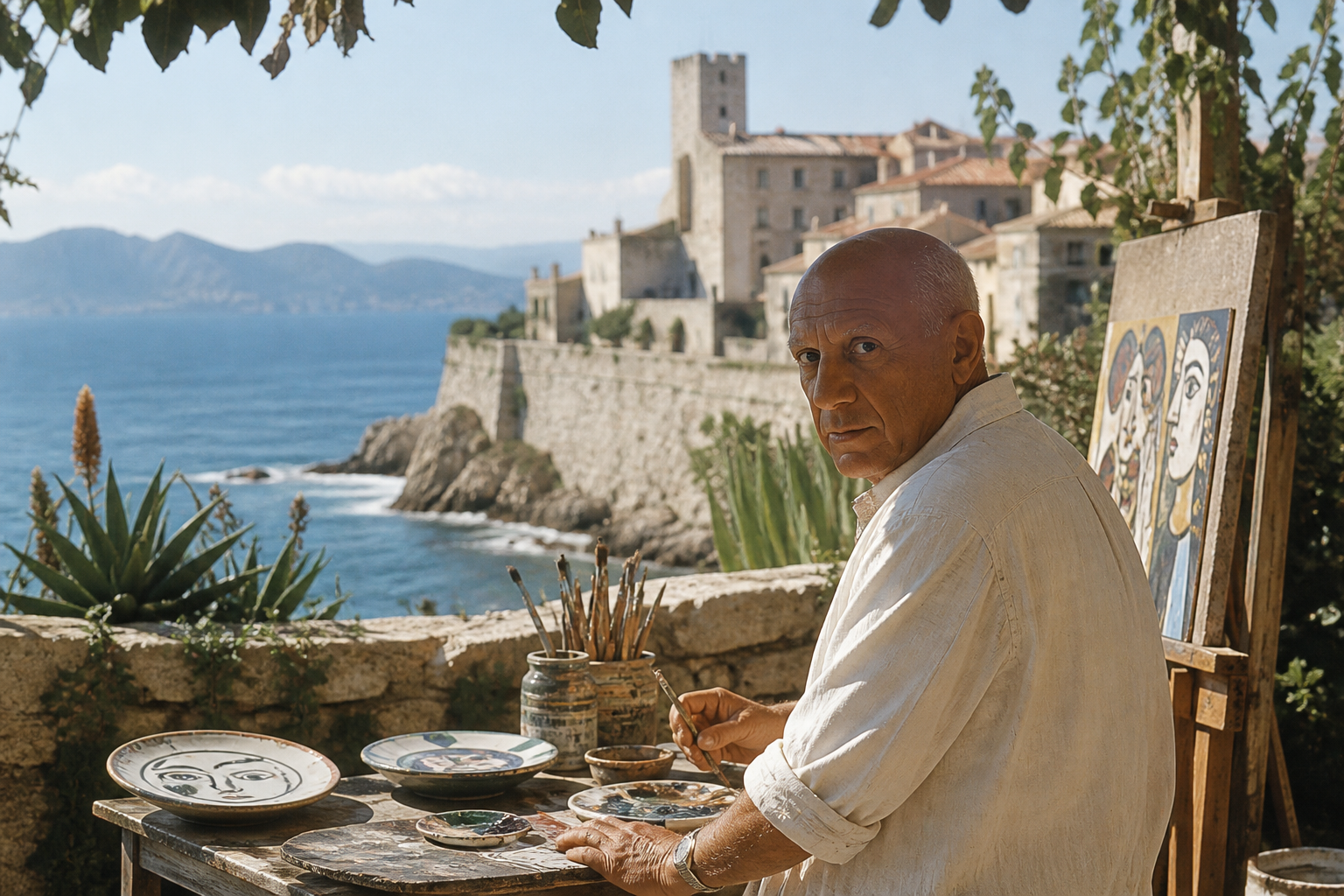
His return to the coast began in Antibes. At his side was the young artist Françoise Gilot, forty years his junior and the only woman who would ultimately dare to leave him. Romuald Dor de la Souchère, curator of the Château Grimaldi, offered him the upper floor as a studio in 1946. Picasso worked there at a feverish pace, painting on whatever he could find—from plywood panels to fibreboard—as canvas was scarce in the postwar years.
A telling anecdote from this period is his encounter with an injured owl in the castle. Picasso bandaged the animal’s leg, named him “Ubu,” and kept him as a companion. The owl quickly appeared in numerous drawings and became one of his many animal alter egos. Upon his departure, he donated dozens of works to the city, laying the foundation for what is now the Musée Picasso Antibes.
The honorary citizen of Vallauris
In 1948, Picasso settled with Françoise and their children, Claude and Paloma, in the pottery village of Vallauris. They moved into the modest villa La Galloise, tucked away on a hillside, but his true kingdom was a former perfume factory in Le Fournas, which he used as a studio.
In 1949, he gifted the village the sculpture Man with Sheep (designed in 1943) as a gesture of thanks for its warm welcome. According to local lore, he rather brazenly had the statue placed in the town square without waiting for official approval. Two years later, in 1951, the town honoured him on his 70th birthday with a legendary public celebration in the castle chapel. Picasso relished his role as the “local master” and even organised bullfights, where he sat as an honorary citizen among the village children.
La Californie: a theatrical world of art and excess
After his break with Françoise in 1953—a blow to his ego he never fully overcame—he found comfort with the young Jacqueline Roque. In 1955, he bought for her the extravagant villa La Californie in Cannes. This stately 19th-century mansion overlooking the bay became a lively stage where even the goat Esmeralda roamed freely and was allowed to sleep indoors. Here, Picasso painted more than seventy portraits of Jacqueline; she became the woman he would obsessively depict during the last seventeen years of his life.
Mougins: the hermit of Notre-Dame-de-Vie
In 1961, seeking greater privacy, Picasso bought the estate Notre-Dame-de-Vie in Mougins as a wedding gift for Jacqueline. To the outside world, it became an impenetrable fortress, surrounded by high walls to keep out prying eyes and intrusive media.
His life there was a paradox: he lived like a recluse, yet worked harder than ever. Jacqueline guarded his peace like a cerberus, while he continued creating late into the night under artificial light; he feared that stopping work would mean stopping life itself. After his death in 1973, Jacqueline left the house almost untouched for decades; even his famous reading glasses remained exactly where he had left them.
A final resting place at the foot of the mountain
His journey ended slightly further inland. He was buried in the garden of his Château de Vauvenargues, at the foot of Mont Sainte-Victoire. He had purchased the château in the late 1950s because it stood on the ground of his great inspiration, Paul Cézanne. With characteristic bravado, he remarked at the time: “I have just bought Cézanne’s mountain.”
This site is protected by reCAPTCHA and the Google Privacy Policy and Terms of Service apply.